


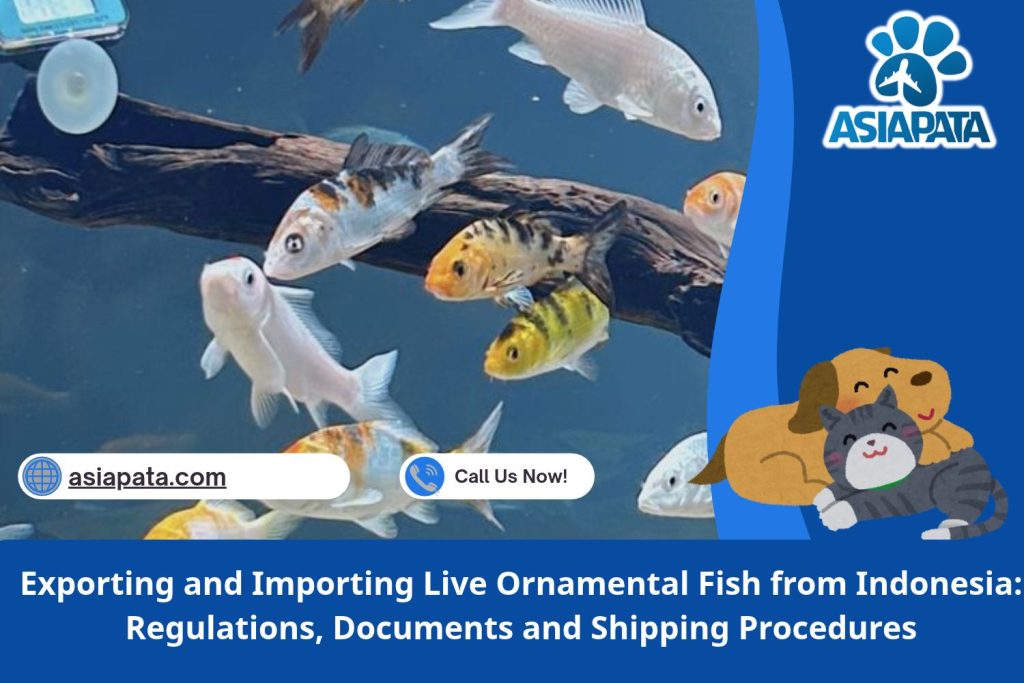
Exporting and Importing Live Ornamental Fish from Indonesia: Regulations, Documents and Shipping Procedures
Indonesia is an important source of tropical ornamental fish. The country supplies various freshwater and marine species to international aquarium markets.
Live fish transportation requires more than ordinary cargo arrangements. Exporters must follow animal health regulations, quarantine procedures, customs requirements, and airline policies.
Importers must also obtain the necessary approvals before the shipment arrives. Missing documents or incorrect declarations may cause delays, additional costs, or shipment refusal.
This article explains the export procedures in Indonesia, import requirements in the destination country, and the steps involved in transporting live ornamental fish by air.
1. Types of Ornamental Fish Exported from Indonesia
Indonesia has a diverse range of freshwater and marine ornamental fish.
Common species include:
- Betta Fish: Popular for their bright colors and distinctive fins.
- Guppies: Small freshwater fish commonly sold to aquarium businesses.
- Discus Fish: Valuable ornamental fish that require stable water conditions.
- Angelfish: Popular freshwater species with elegant body shapes.
- Clownfish: Marine ornamental fish commonly kept in saltwater aquariums.
- Other Tropical Fish: Various species supplied for aquarium keeping and breeding.
Before exporting, the seller must identify each species accurately. The scientific name is particularly important because export and import regulations may differ between species.
Some fish may also be protected under CITES or national wildlife regulations. Their export may require additional permits or may be restricted.

2. Regulations for Exporting Live Fish from Indonesia
Live ornamental fish are subject to Indonesian fish quarantine and export controls.
Exporters must comply with the applicable requirements of Indonesian authorities, including the Indonesian Quarantine Agency (Badan Karantina Indonesia).
The main regulatory requirements include:
Fish quarantine requirements
Live fish must undergo quarantine procedures before export. Authorities may check the species, quantity, physical condition, and health status of the shipment.
Fish health certification
A Fish Quarantine Health Certificate, commonly referred to as KI-1, may be issued after the fish pass the required inspection and quarantine procedures.
Destination country requirements
Exporters must check the health certification and import conditions required by the destination country. Additional laboratory tests or disease declarations may be necessary.
Wildlife and protected species regulations
Fish listed under CITES may require specific export permits and supporting documents. Some species may be subject to restrictions or prohibitions.
Customs regulations
Exporters must complete the applicable customs declaration procedures. The shipment must have accurate commodity descriptions, quantities, values, and supporting documents.
The exact requirements depend on the fish species, origin, and destination.

3. Documents Required for Exporting Ornamental Fish from Indonesia
The exporter should prepare the following documents before shipment.
3.1. Commercial Invoice
The Commercial Invoice records the transaction between the exporter and importer.
It should include:
- Exporter’s and importer’s information.
- Fish species and scientific names.
- Quantity and unit price.
- Total shipment value.
- Country of origin.
- Currency and payment terms.
3.2. Packing List
The Packing List provides details about the shipment packaging.
It should show:
- Number of boxes.
- Number of bags.
- Fish species in each package.
- Quantity of fish.
- Gross weight and package dimensions.
3.3. Fish Quarantine Health Certificate
This document confirms that the shipment has undergone the required fish quarantine procedures.
In Indonesia, the relevant quarantine authority may issue the KI-1 certificate after the inspection requirements have been fulfilled.
The destination country may also require specific disease declarations or laboratory test results.
3.4. Export Customs Declaration
The exporter must complete the applicable Indonesian customs declaration, known as the Pemberitahuan Ekspor Barang (PEB), when required.
The declaration contains information about the goods, exporter, destination, and shipment value.
3.5. Air Waybill
The Air Waybill (AWB) is the transport document issued by the airline or its authorized agent.
It identifies the shipper, consignee, airport of departure, destination, and shipment details.
3.6. CITES Export Permit
This document is required when the exported fish species is listed under CITES and the relevant trade requires a permit.
Not every ornamental fish requires a CITES document. The exporter must check the scientific name against the applicable CITES appendices.
4. Export Procedures for Live Ornamental Fish from Indonesia
The export process generally includes the following steps.
Step 1: Identify the Fish Species
The exporter identifies the common and scientific names of the fish.
The species, quantity, origin, and intended purpose must be recorded accurately.
This information is used to determine the applicable export and import requirements.
Step 2: Check Export and Import Regulations
Before confirming the order, the exporter must check whether the fish can legally be exported from Indonesia.
The importer must also verify the requirements of the destination country.
These checks may include:
- Export restrictions.
- Import permits.
- Quarantine requirements.
- Health certificates.
- CITES permits.
- Airline acceptance conditions.
The shipment should not be booked until the necessary conditions are confirmed.
Step 3: Prepare the Export Documents
The exporter prepares the Commercial Invoice, Packing List, and other supporting documents.
The exporter should also contact the Indonesian quarantine authority to arrange the required inspection and certification.
Step 4: Apply for Fish Quarantine Inspection
The exporter submits an application for export fish quarantine services.
The application may be submitted electronically or through the applicable service channel.
Supporting documents may include the Invoice, Packing List, Certificate of Analysis when required, and other documents requested by the destination country.
Step 5: Physical Inspection and Health Examination
Quarantine officers review the documents and inspect the fish.
The inspection may include:
- Verification of fish species.
- Quantity checking.
- Physical condition assessment.
- Examination for signs of disease.
- Sampling and laboratory testing when necessary.
If the fish do not meet the applicable requirements, the shipment may be rejected or subjected to further quarantine measures.
Step 6: Receive the Quarantine Health Certificate
After the shipment passes the required inspection and the applicable fees are paid, the authority may issue the KI-1 Fish Quarantine Health Certificate.
This document supports the export process and confirms compliance with the applicable fish quarantine requirements.
Step 7: Complete Customs Procedures
The exporter or customs representative submits the required export declaration.
Customs authorities review the declaration and supporting documents. Physical inspection may be conducted when required by the risk management system.
Step 8: Book Air Cargo and Deliver the Shipment
The exporter arranges air cargo transportation with an airline that accepts live aquatic animals.
The shipment is delivered to the designated cargo terminal. Airline staff check the packaging, labels, documents, and acceptance conditions before loading.
Step 9: International Transportation
The shipment is transported to the destination airport.
The exporter or logistics provider should monitor the flight and coordinate with the importer to prepare for arrival.

5. Import Regulations for Live Ornamental Fish into Vietnam
When ornamental fish are imported into Vietnam from Indonesia, the importer must check the applicable fisheries, quarantine, and customs regulations.
Vietnam’s regulations distinguish between species permitted for trade and species that require additional assessment or licensing.
Important requirements include:
Aquatic animal quarantine
Live fish are generally subject to aquatic animal quarantine under the applicable regulations.
Circular No. 03/2026/TT-BNNMT, effective from January 13, 2026, provides the current framework for quarantine of aquatic animals and aquatic animal products.
Risk assessment and import licensing
Some live aquatic species may require risk assessment and an import permit before shipment.
This is particularly important for species used for breeding or species that are not included in the relevant permitted lists.
Protected species
Fish listed under CITES or other wildlife protection regulations may require additional permits.
Customs clearance
The importer must declare the goods accurately and complete the applicable import customs procedures.
The importer should confirm the requirements for the exact species before the exporter ships the fish.
6. Documents Required for Importing Fish into Vietnam
Depending on the species and purpose of import, the importer may need the following documents:
| Document | Purpose |
|---|---|
| Import permit, where required | Authorizes the importation of regulated live fish |
| Fish Health Certificate | Confirms the health status of the shipment |
| Quarantine registration | Registers the shipment for import quarantine |
| Commercial Invoice | Shows transaction value and commercial details |
| Packing List | Describes package numbers, quantities, and weights |
| Air Waybill | Confirms the air transportation details |
| CITES Permit | Applies to regulated CITES-listed species |
| Import customs declaration | Declares the shipment to customs authorities |
Not every shipment requires every document. The importer should confirm the exact list with the competent Vietnamese authorities.
7. Import Procedures for Live Ornamental Fish into Vietnam
Step 1: Check Whether the Species Is Allowed
The importer must identify the scientific name of the fish.
The species should be checked against the relevant lists of aquatic species permitted for trade, protected species, and species subject to risk assessment.
Step 2: Apply for an Import Permit if Required
If the species falls under a category requiring risk assessment or an import license, the importer must complete the relevant procedure before shipment.
The application may require information about:
- Fish species and scientific names.
- Country of origin.
- Quantity and intended purpose.
- Exporter information.
- Import location.
- Quarantine and disease control arrangements.
The importer should obtain the necessary approval before confirming the shipping date.
Step 3: Register for Import Quarantine
The importer prepares the required quarantine registration documents.
Depending on the applicable procedure, these may include the registration form, export health certificate, and transport document.
The shipment should be registered according to the instructions of the competent quarantine authority.
Step 4: Receive the Shipment at the Airport
When the fish arrive, the importer or authorized representative coordinates with the airline, cargo terminal, and quarantine authority.
The documents and shipment details are checked against the actual cargo.
Step 5: Conduct Quarantine Inspection
The competent authority may inspect the fish and review their health documents.
Sampling or laboratory testing may be required when necessary.
If the shipment meets the requirements, the authority completes the relevant quarantine procedures.
Step 6: Complete Customs Clearance
The importer or customs broker submits the import declaration and supporting documents.
Customs authorities review the shipment and determine whether additional inspection is necessary.
Step 7: Receive and Transport the Fish
After the required quarantine and customs procedures are completed, the fish can be released.
The importer should arrange suitable transportation to the final destination without unnecessary delay.
8. Packaging Requirements for Live Fish Transportation
Proper packaging helps protect fish during international air transportation.
The packaging method should be suitable for the species, size, quantity, and journey duration.
Leak-proof plastic bags
Fish are usually placed in strong plastic bags containing an appropriate amount of water.
Oxygen supply
The remaining space in the bags may be filled with oxygen according to the packaging method.
Double or triple bagging
Additional bags help reduce the risk of leakage during handling.
Insulated containers
Styrofoam boxes or other suitable insulated containers can help maintain more stable temperatures.
Package identification
Each package should carry the necessary shipping labels and handling instructions.
The exporter must follow the applicable airline and live animal transport requirements. Packaging should also allow inspection when required by the destination country’s quarantine authority.
9. Airline Requirements for Live Ornamental Fish
Not all airlines accept live fish on every route.
Before booking, the shipper should confirm:
- Whether the airline accepts live aquatic animals.
- Whether the selected route supports live animal shipments.
- Whether transit airports allow the transfer of live fish.
- Packaging and labeling requirements.
- Maximum package dimensions and weight.
- Required cargo documents.
- Acceptance deadlines before flight departure.
The airline may refuse shipments that do not meet its acceptance conditions.
A direct flight or a route with fewer transfers may help reduce transportation time and handling risks.
10. Common Risks During Export and Import
Live fish shipments may encounter several problems.
Incomplete documentation
Missing health certificates, permits, or customs documents may delay clearance.
Incorrect species declaration
Using only common names can create confusion. Scientific names should be provided to support accurate identification.
Import restrictions
Some species may be prohibited or require additional approval in the destination country.
Fish mortality
Poor oxygen supply, temperature changes, and extended transit times can affect fish survival.
Flight delays
Unexpected delays may increase the time fish spend inside transport containers.
Quarantine rejection
Fish that show signs of disease or fail to meet health requirements may be detained, treated, returned, or otherwise handled under the applicable regulations.
To reduce these risks, both exporter and importer should coordinate before the shipment is booked.
11. Checklist Before Shipping Fish from Indonesia
Exporters and importers should review the following items:
-
Confirm the common and scientific names of the fish.
-
Check whether the species can be legally exported.
-
Verify destination country import requirements.
-
Obtain an import permit when required.
-
Arrange fish quarantine inspection in Indonesia.
-
Prepare the required health certificate.
-
Prepare the Commercial Invoice and Packing List.
-
Obtain CITES documents when applicable.
-
Confirm airline acceptance and flight availability.
-
Prepare suitable packaging and oxygen supply.
-
Arrange airport handling and arrival clearance.
-
Coordinate final delivery after release.
12. International Live Fish Transportation Support by AsiapaTa
International transportation of ornamental fish requires careful coordination between exporters, importers, airlines, and quarantine authorities.
AsiapaTa supports customers with shipment consultation and transportation arrangements for live animals, subject to route availability and applicable regulations.
To assess a shipment from Indonesia, customers should provide:
- Fish species and scientific names.
- Number of fish.
- Country and city of origin.
- Destination country and city.
- Expected shipping date.
- Available export and import documents.
The shipment can then be reviewed to determine the applicable requirements and suitable transportation options.
13. Conclusion
Exporting live ornamental fish from Indonesia involves several important stages. These include species identification, regulatory checks, quarantine inspection, health certification, customs declaration, and air cargo booking.
Importers must also prepare the required permits and quarantine documents before the shipment arrives.
The most important step is to verify the regulations for each fish species and destination country before transportation. Proper planning helps reduce delays, avoid unnecessary costs, and protect the health of live fish during international shipping.
Xem thêm: IMPORTING AND TRANSPORTING BREEDING BIRDS TO VIETNAM: REGULATIONS, DOCUMENTS AND PROCEDURES
Xem thêm: Can Pregnant Pets Travel by Air? Risks and Important Considerations
Xem thêm: Why Are More International Airports Building Pet Relief Areas?
CLICK ĐỂ TẢI TÀI LIỆU ĐẦY ĐỦ TẠI ĐÂY
