


Airline-Approved Travel Crate Size Requirements
A Complete Guide for Safe International Pet Transport
Choosing the correct travel crate size is one of the most important steps when preparing a pet for air travel. Airlines worldwide follow strict IATA (International Air Transport Association) standards to ensure animals are transported safely, comfortably and without stress.
This article explains the crate size requirements for each pet category, how to measure your pet correctly, and what airlines expect before accepting an animal for international air transport.
1. Why the Right Crate Size Matters
A properly sized travel crate keeps pets safe and reduces risks during the journey. An undersized crate may cause stress, difficulty breathing or injuries when pets attempt to stand or turn. A crate that is too large can make pets unstable during turbulence.
Airlines require owners to follow IATA standards to ensure:
-
Enough space for standing, sitting, lying and turning naturally
-
Adequate ventilation
-
Structural safety during loading, transfer and landing
-
Avoidance of excessive pressure or stress
Selecting the correct crate is not only a safety requirement but also a mandatory condition for airline approval.
2. IATA Standard Formula for Travel Crate Size
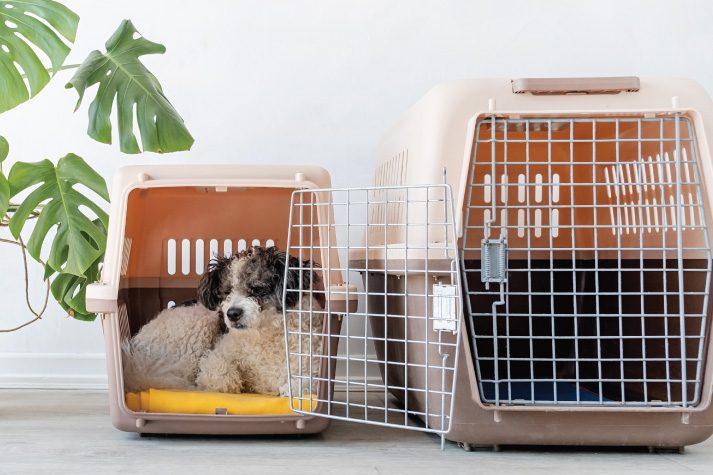
To meet airline regulations, pet owners must measure their pets accurately. IATA provides the following formula:
A = Length of pet (from nose tip to base of tail)
B = Height from ground to elbow joint
C = Width of pet at widest point
D = Height from ground to top of head or ears (whichever is higher)
Using these measurements:
Crate Length = A + ½ B
Crate Width = C × 2
Crate Height = D
This ensures your pet can stand upright without touching the top, turn comfortably and lie down naturally.
3. Airline-Approved Crate Size Categories
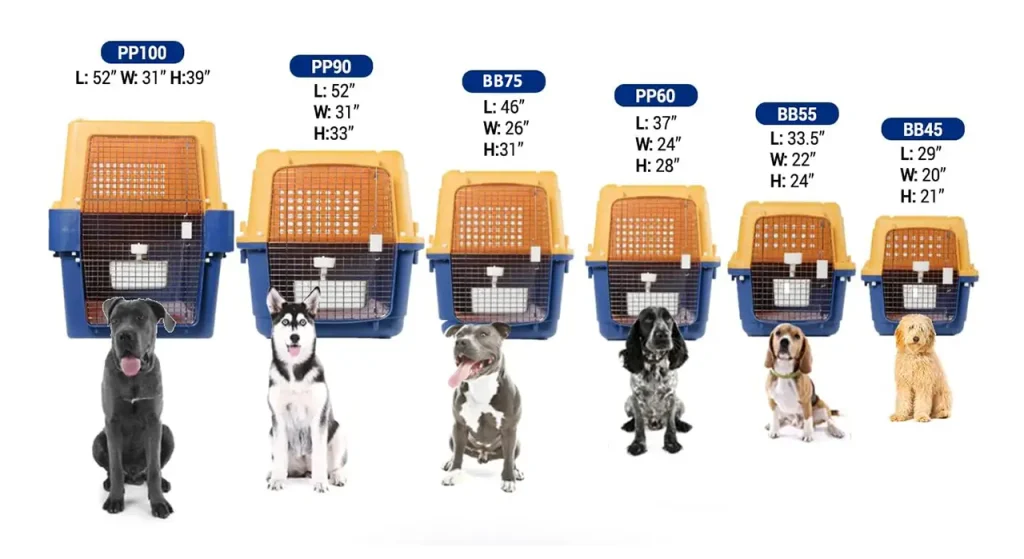
Most airlines accept IATA-approved crates categorized by size. While brands may differ, the following breakdown is commonly accepted.
Size 100 (Small)
Suitable for: Toy breeds, kittens, small cats
Typical internal dimensions: approx. 48 × 32 × 32 cm
Used for: Pets under 5 kg
Size 200 (Medium)
Suitable for: Poodle, Shih Tzu, small to medium cats
Dimensions: approx. 57 × 37 × 39 cm
Used for: Pets 5–8 kg
Size 300 (Large)
Suitable for: Beagle, Cocker Spaniel, medium cats, larger small-breed dogs
Dimensions: approx. 64 × 48 × 48 cm
Used for: Pets 8–12 kg
Size 400 (Extra Large)
Suitable for: Border Collie, Bulldog (non-brachy on specific airlines), larger breeds
Dimensions: approx. 75 × 50 × 55 cm
Used for: Pets 12–18 kg
Size 500 (Giant)
Suitable for: Golden Retriever, German Shepherd, Labrador
Dimensions: approx. 90 × 60 × 68 cm
Used for: Pets 18–30 kg
Size 600 (Super Giant)
Suitable for: Alaskan Malamute, Husky, large working breeds
Dimensions: approx. 100 × 67 × 75 cm
Used for: Pets 30–45 kg
Size 700 (Ultra Giant)
Suitable for: Extra-large dogs, oversized breeds
Dimensions: approx. 120 × 80 × 86 cm
Used for: Pets over 45 kg
Note: Airlines may refuse crates smaller than the minimum required size even if the pet fits inside. Oversized crates may also be rejected if they exceed aircraft cargo limits.
4. Requirements for Airline-Approved Travel Crates
For a crate to be accepted, it must meet the following IATA standards:
4.1. Structure
-
Hard plastic or fiberglass construction
-
Metal door with dual-side locking system
-
Strong bolts securing top and bottom parts
-
No wheels (must be removed before check-in)
4.2. Ventilation
-
Minimum 3 sides with ventilation for small crates
-
4-side ventilation required for larger sizes (above size 400)
4.3. Interior Comfort
-
Absorbent pad or pet liner
-
No pillows or loose soft materials
-
Water container securely attached inside the crate
-
Food dish for long-haul flights (airline may require)
4.4. Pet Fit
The pet must be able to:
-
Stand naturally without touching the roof
-
Turn around without difficulty
-
Lie down comfortably in a natural position
If any of these conditions are not met, the airline has the authority to reject the crate at the airport.
5. Crate Requirements for Brachycephalic (Snub-Nosed) Breeds
Breeds such as French Bulldog, Pug, Shih Tzu, Persian Cat and Himalayan Cat generally require one crate size larger than standard. This helps reduce breathing pressure and ensures better ventilation.
Some airlines may require reinforced metal crates for these breeds.
Owners should check airline-specific rules before booking flights.
6. How ASIAPATA Supports You With the Correct Crate Selection
ASIAPATA specializes in international pet relocation and ensures your travel crate meets all IATA and airline requirements. Our services include:
-
Accurate measurement of your pet
-
Recommendation of the correct IATA crate size
-
Provision of airline-approved crates
-
Pre-flight inspection to ensure compliance
-
Guidance for specific airlines and routes
Choosing the correct crate size is essential to ensure a safe and stress-free journey for your pet. ASIAPATA is committed to providing professional support throughout the entire international transport process.
7. Conclusion
Airlines strictly enforce crate size standards to ensure the safety and comfort of pets during flights. Using an IATA-approved crate with the correct dimensions helps prevent check-in issues and protects your pet during long international travel.
If you need support selecting the correct crate size or preparing for a flight, ASIAPATA is ready to assist with professional guidance and full relocation services.
Read more:
